The world's first and only complete engineering superharness
then run srooterctl login →
Coding agents write code. Palgu runs engineering.
Everyone built a harness for agents. We built one for engineering. Palgu takes work from intent to a proven, governed change. It finds what the task really needs, runs every agent as one team, proves each result and repairs itself when something goes wrong. Use it with srooterctl in the terminal or Palgu Studio on the desktop.
$bash
>PowerShell
▸add partial refunds to the billing API
HARNESS
intenta refund must never exceed the captured amountnot in the ticket
contextmapped blast radius → payments · ledger · invoiceslive project map
riskHIGH · money + auth path
practicetests required before implementationyour org standard
modelefficient model implements · another model family reviewsby risk tier
validatebuild ✓ e2e ✓ visual ✓Validation Center
reviewindependent review · 1 blocker caught and fixednot the author
1 blocker caught: refund > captured amount → fixed before review
One request. Your context, standards and policy, applied automatically.
CODE WITH
srooterctlStudioor route Claude Code, Codex, Cursor, aider
ANY MODEL
58×6 of 6 models passed the same tests inside Palgu. The model changed the cost. The harness kept the result. See the proof →
frontieropenlocalor your own keys
THE CATEGORY
Everyone built a harness for agents. We built one for engineering.
Running more agents doesn't make a superharness. Running the engineering system does. On the left, what an agent orchestrator does. On the right, what Palgu does, across all eight layers of engineering.
A complete engineering superharness covers all eight. Palgu does.
Passes the ticket to an agent as written→Intent: finds what the ticket did not say
Gives the agent the files→Architecture: knows the system as built and records decisions
Gives every task the same prompt→Knowledge: applies the right expertise and your standards
Runs agents side by side, finds conflicts at merge→Coordination: runs agents as one team, finds conflicts first
Trusts the agent when it says done→Evidence: done means proven, missing evidence is never a pass
Retries, or stops and waits for a person→Recovery: sees when the harness itself is unhealthy, repairs it
Leaves settings to each tool→Governance: one policy, budget and audit for every agent
Keeps memory per agent or per tool→Learning: every task improves your engineering
srooterctlStudioClaude CodeCodexCursoraideryour agents
Palgu superharnesseight layers · owned by your team · applied to every task
IntentFinds what the ticket did not say
ArchitectureThe system as built and its decisions
KnowledgeThe right expertise and your standards
CoordinationMany agents working as one team
EvidenceTests, screens and independent review
RecoveryRepairs the harness itself and resumes
GovernancePolicy, budgets, allowlists, audit
LearningEvery task improves the next one
frontier modelsopen modelslocal · Ollamayour own keys
Developers pick the agent. Palgu runs the engineering.
HOW IT WORKS
Install srooterctl and start coding.
01 · Install
One install, one sign-in.
Run srooterctl for a coding session, or srooterctl -p to run one task and exit. Every request goes through the Palgu API.
# sign in once, then code
srooterctl login
srooterctl -p "fix the failing test"
srooterctl login
srooterctl -p "fix the failing test"
02 · Apply your standards
Your context, practice and model policy, per task.
Palgu assembles the right code context, enforces your TDD, architecture and review practice, and picks the model for the task.
policy: tests-before-code
context: code-graph + ADRs
model: by task and risk
context: code-graph + ADRs
model: by task and risk
03 · Ship with evidence
Validate and review before the PR.
Functional and visual validation, a review by models that did not write the code, and an audit record for each change.
✓ validated · reviewed
✓ 8/8 checks
✓ audit 7f3a2b recorded
✓ 8/8 checks
✓ audit 7f3a2b recorded
THE WALKTHROUGH
Example: one task, end to end.
A developer types add partial refunds. Here is everything Palgu does before the PR opens.
The model writes the code.
Palgu runs the other eight steps.
- 01Maps the blast radiusResolves the change fan-out: payments, ledger and invoices. Selects the tests that matter.live project map
- 02Assembles the architecturePulls the relevant ADRs and codemap, including the append-only ledger invariant.decision records · ADR-041
- 03Grades the riskMoney movement on an auth path. Tier: high. An independent risk model scores it, blind to the solver.independent risk check
- 04Requires tests firstYour TDD standard applies: failing tests before implementation.org policy · tests-before-code
- 05Picks the model for the tierImplementation on the efficient default. High-risk tasks get a frontier model as reviewer.model by task size and risk
- 06Implements against the testsThe agent works inside the assembled context while Palgu records a session-memory trace you can inspect.team memory
- 07Validates functionally and visuallyBuild, end-to-end and screenshot proof attached to the change.Validation Center
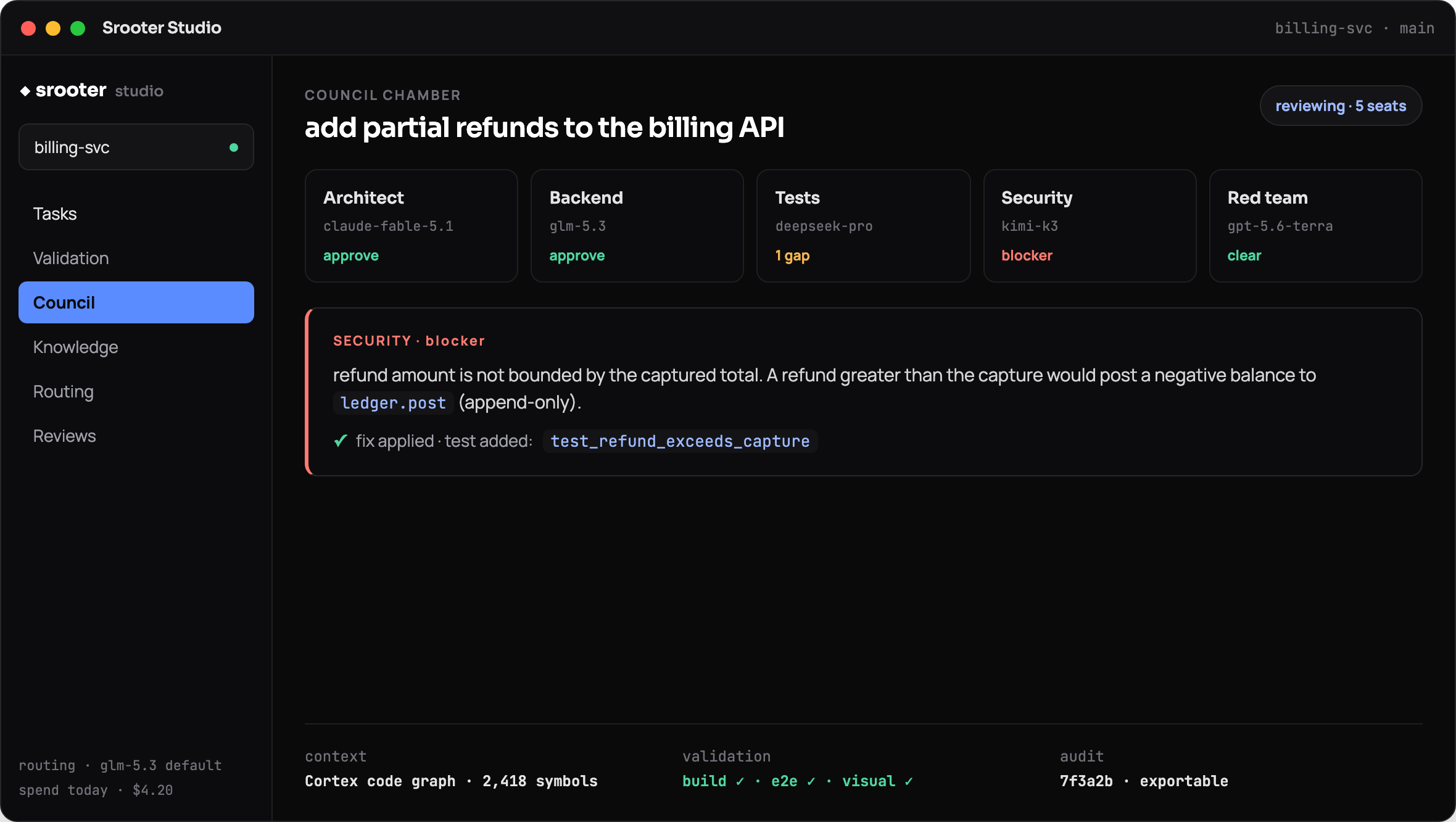
- 08Convenes independent reviewFive seats (architect, backend, frontend, tests, security) on models that did not write the code. One blocker caught and fixed.independent review
- 09Records the outcomeContext, model, tests, review and outcome in the audit ledger. PR #482 opens with 8/8 checks.audit + provenance
ONE HARNESS · THREE OUTCOMES
Your engineering standards, applied to agent-written code.
CODE GRAPH · billing-svc2,418 symbols · 11 ADRs
impactpayments/refund.py → ledger/post.py → invoices/render.py
adrADR-041 idempotent money movements
dangerledger.post is append-only
teststests/payments/test_refund.py (required first)
reviewcouncil: architect · backend · tests · security · red-team
verdictAPPROVE after 1 fix
HOWlive code graph · org skills · multi-model council · functional and visual validation
ARCHITECTURE AND DEPLOYMENT
Centrally managed. Runs where you need it.
Palgu servers never run your code: tests run in your CI or on the developer machine. The audit log stores a SHA-256 hash of each prompt, not its text. Conversation transcripts are stored separately, with retention your admins control (30 days by default), and encrypted on the managed service (self-hosted: depends on your key setting).
SaaSSelf-hosted gatewayBYOKLocal / sovereign modelsSSO (OIDC · SAML)Audit exportData residency
Read the platform-team checklist →
agents
srooterctlStudioClaude CodeCodexCursor
runs ondev machines · your CI · your VPC
harness
PalguSaaS or self-hosted gateway
policyallowlists · budgets · SSO · audit ledger · residency
models
frontieropensovereign / localBYOK
WHERE IT RUNS
In your terminal, in CI and on your Mac.
srooterctl runs on macOS, Linux and Windows, on developer machines and CI runners. Studio puts Tasks, the Validation Center, the Council Chamber, Knowledge and Routing in one macOS app.
srooterctlThe superharness in your terminal, for macOS, Linux and Windows. Use it instead of claude or codex: every request goes through your gateway.Install →
Studio for macOSTasks, Validation Center, Council Chamber, Knowledge and Routing in one desktop app.Download for Mac →
CI and scriptssrooterctl -p runs one task and exits. srooterctl review exits 1 when the council requests changes.Download →
Your existing toolsKeep Claude Code or Codex: srooterctl enable routes them through Palgu (opt-in). Cursor and aider connect to the endpoint.See integrations →
PROOF
Same harness. Any model. The same result.
We build a real app through Palgu with pinned models and score it on four axes: accuracy, speed, cost and quality. The model changes the cost. The harness keeps the outcome. Every result is public.
6 of 6Models passed the same testsSix models built the same app inside Palgu and met the same acceptance criteria.
58×Cost spread for the same resultThe model changed the cost. The harness kept the outcome.
4Axes scoredAccuracy (Playwright), speed, cost (tokens by price), quality (screenshots).
0Decisions made by a model aloneA test, a tool or a person makes the call. Missing evidence is never a pass.
Benchmark conditions, task, commit, model versions and per-run costs are published with every result.See the live benchmarks →