The engineering harness for AI coding agents
Your engineering harness.
Your engineering harness.
Any agent. Any model.
Your developers keep Claude Code, Codex and Cursor, or use srooter's own agent and Studio app. Either way, one layer underneath gives every agent your organization's code context, standards, reviews and model policy.
$macOS · Windows · Linux
▸add partial refunds to the billing API
HARNESS
contextmapped blast radius → payments · ledger · invoicesCortex code graph
riskHIGH · money + auth path
practicetests required before implementationyour org standard
modelglm-5.3 implements · claude-fable-5.1 reviewsby risk tier
validatebuild ✓ e2e ✓ visual ✓Validation Center
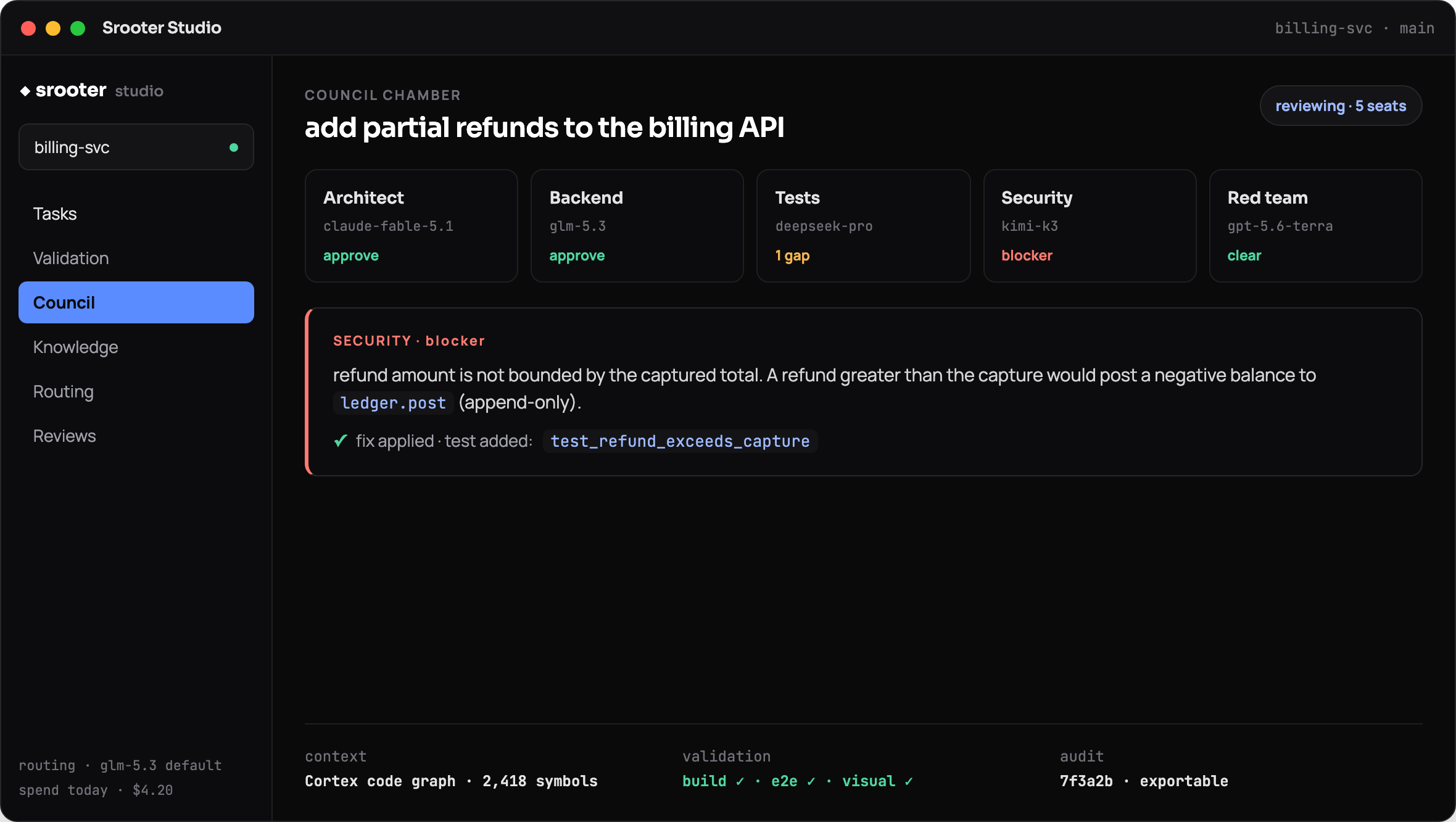
reviewcouncil · 5 seats · 1 blocker caught and fixedindependent models
1 blocker caught: refund > captured amount → fixed before review
One request. Your context, standards and policy, applied automatically.
WORKS WITH
Claude CodeCodexCursoraidersrooterctlyour internal agents
RUNS ON
58×6 frontier models built the same app. Same result, 58× cost spread. We measure it →
AnthropicOpenAIGoogleDeepSeekGLMKimilocal · Ollama
THE PROBLEM
Coding agents scaled faster than the system around them.
Software engineering has become agent-first, and model providers stay heterogeneous. What is missing is the layer the organization owns, knowledge, memory, process, evaluation and model policy, that every agent runs inside.
One shared harness fixes it.
Every developer assembles their own AI setup→One harness, defined by your platform team
Each agent sees different context→The right code context per task, from a live code graph
Architecture knowledge scattered in docs→ADRs and codemaps delivered to the agent
Memory dies between sessions→Task-scoped memory that survives compaction
Models chosen ad hoc, by whoever is driving→Model chosen by task, risk and policy
Nobody can see what any agent did→Every decision validated, reviewed and recorded
Claude CodeCodexCursoraidersrooterctlyour agents
srooter harnessowned by your platform team · applied per task
KnowledgeCode graph, blast radius, ADRs, codemaps
MemoryTask-scoped state across sessions
PracticeTDD, architecture and review standards
ValidationFunctional and visual proof on every change
ReviewIndependent multi-model council
Model policyRouting, budgets, allowlists, audit
AnthropicOpenAIGoogleDeepSeekGLMKimiOllama · localyour models
Developers choose their agents. The organization owns how engineering gets done.
HOW IT WORKS
Point your agents at Srooter. Keep your tools. Gain a system.
01 · Connect
One endpoint. Nothing else changes.
OpenAI- and Anthropic-compatible. Claude Code, Codex and Cursor keep working exactly as they do today.
# one line, nothing else changes
export ANTHROPIC_BASE_URL=api.srooter.ai
export ANTHROPIC_BASE_URL=api.srooter.ai
02 · Apply your standards
Your context, practice and model policy, per task.
Srooter assembles the right code context, enforces your TDD, architecture and review practice, and picks the model for the task.
policy: tests-before-code
context: code-graph + ADRs
model: by task and risk
context: code-graph + ADRs
model: by task and risk
03 · Ship with evidence
Validated, reviewed, recorded.
Functional and visual validation, independent multi-model review, and a full audit trail on every change.
✓ validated · reviewed
✓ 8/8 checks
✓ audit 7f3a2b recorded
✓ 8/8 checks
✓ audit 7f3a2b recorded
THE WALKTHROUGH
One task. The whole harness.
A developer types add partial refunds. Here is everything Srooter does before the PR opens.
The model is one step.
The harness is the other nine.
- 01Maps the blast radiusResolves the change fan-out: payments, ledger and invoices. Selects the tests that matter.Cortex code graph
- 02Assembles the architecturePulls the relevant ADRs and codemap, including the append-only ledger invariant.Codemap · ADR-041
- 03Grades the riskMoney movement on an auth path. Tier: high. An independent risk model scores it, blind to the solver.risk pipeline
- 04Requires tests firstYour TDD standard applies: failing tests before implementation.org policy · tests-before-code
- 05Picks the model for the tierImplementation on the efficient default. The high-risk tier earns a frontier reviewer.blast-radius routing
- 06Implements against the testsThe agent works inside the assembled context, with task memory that survives compaction.Mnemos
- 07Validates functionally and visuallyBuild, end-to-end and screenshot proof attached to the change.Validation Center
- 08Convenes independent reviewFive seats (architect, backend, frontend, tests, security) on models that did not write the code. One blocker caught and fixed.Council
- 09Records everythingContext, model, tests, review and outcome in the audit ledger. PR #482 opens with 8/8 checks.audit + provenance
ONE HARNESS · THREE OUTCOMES
Everything an agent needs to engineer like your best team.
CODE GRAPH · billing-svc2,418 symbols · 11 ADRs
impactpayments/refund.py → ledger/post.py → invoices/render.py
adrADR-041 idempotent money movements
dangerledger.post is append-only
teststests/payments/test_refund.py (required first)
reviewcouncil: architect · backend · tests · security · red-team
verdictAPPROVE after 1 fix
HOWlive code graph · org skills · multi-model council · functional and visual validation
ARCHITECTURE AND DEPLOYMENT
Centrally managed. Runs where you need it.
Sensitive work stays on your infrastructure. Tenant code runs in your CI, never in Srooter. Prompts are hashed and redacted for audit, never stored in plaintext.
SaaSSelf-hosted gatewayBYOKLocal / sovereign modelsSSO (OIDC · SAML)Audit exportData residencyFull VPC harness · roadmap
Read the platform-team checklist →
agents
Claude CodeCodexCursorsrooterctl
runs ondev machines · your CI · your VPC
harness
srooterSaaS or self-hosted gateway
policyallowlists · budgets · SSO · audit ledger · residency
models
frontieropensovereign / localBYOK
AVAILABLE EVERYWHERE
In your terminal, on your desktop, inside the tools you already use.
Studio brings Tasks, the Validation Center, the Council Chamber, Knowledge and Routing into one desktop app for macOS. The gateway, agent and shell run everywhere else.
srooterctlThe CLI agent and session shell. One install, session-scoped routing, no global env changes.Install →
Studio for macOSTasks, Validation Center, Council Chamber, Knowledge and Routing in one desktop app.Download for Mac →
Inside your toolsClaude Code, Codex, Cursor and aider connect with a single endpoint change.See integrations →
PROOF
Spend frontier intelligence where it matters.
We build a real app through the harness with pinned models and score it on four axes: accuracy, speed, cost and quality. The results drive our routing defaults, and they are public.
58×Cost spread, same resultSix frontier models built the same app to the same acceptance criteria.
4Axes scoredAccuracy (Playwright), speed, cost (tokens by price), quality (screenshots).
12Providers, incl. localAnthropic, OpenAI, Google, DeepSeek, GLM, Kimi, Groq, Ollama and more.
5Independent review seatsArchitect, backend, frontend, tests, security, plus an optional red team.
Benchmark conditions, task, commit, model versions and per-run costs are published with every result.See the live benchmarks →